
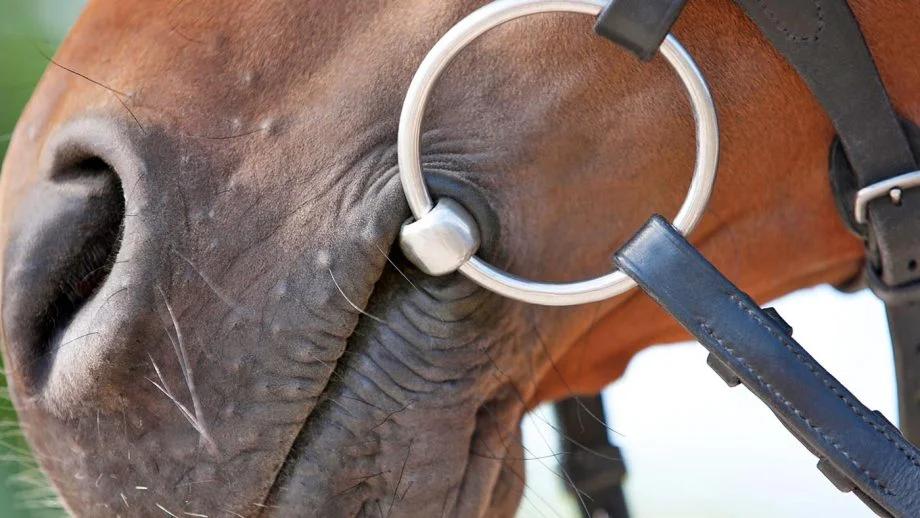
Types of Bits
In order to select the right bit, it
is important to first understand the principles of how a bit functions and the
pressure points on the horse that are affected by different bit types and
designs. The two basic types of bits are snaffle bits and leverage (curb) bits.
These differ in the areas on the horse where each applies pressure. In addition
to these two types of bits, there are hackamores, which generally do not have a
mouthpiece. Hackamores may either be true hackamores (bosal or sidepulls),
which are direct pull devices, or mechanical hackamores, which employ leverage.
There are also many pieces of headgear that combine a mouthpiece with a
mechanical hackamore as well as several options that combine a snaffle bit with
a piece over the nose that does not incorporate leverage.
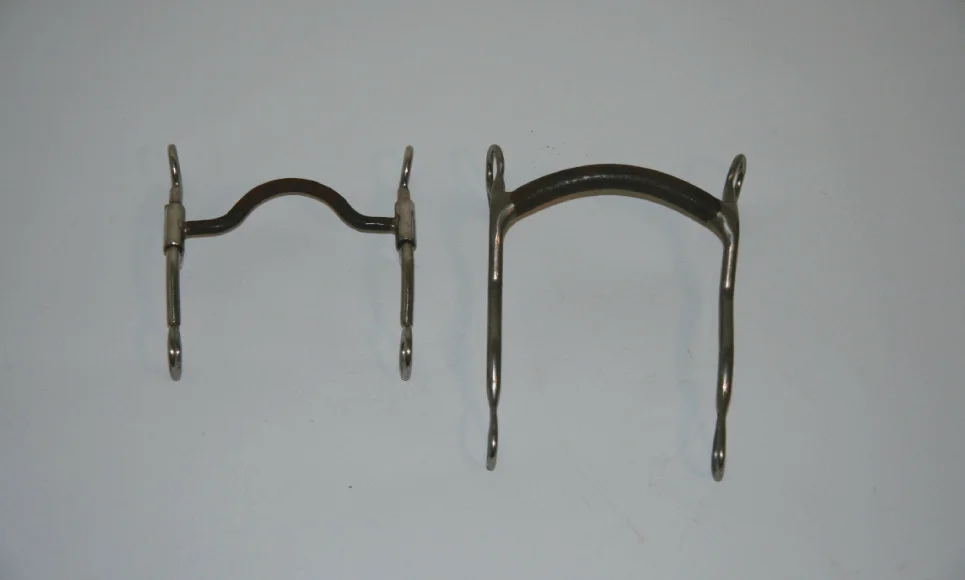
Figure 1. Examples of a
commonly seen snaffle bit (left) and curb bit (right). Notice that on the
snaffle bit, reins attach directly to the mouthpiece while on the curb bit,
reins attach to a shank attached to the mouthpiece.

The points on the horse's head that
can be affected by a bit or some type of headgear include the tongue, bars,
cheeks, lips, palate, nose, curb area and poll. Some pieces of headgear may be
able to affect nearly all of these points while some may only affect two or
three of these points. Snaffle bits are considered direct pull bits because
when the rider pulls on the reins, that pressure is transmitted directly to the
horse's mouth. It is a common misconception in the industry that a snaffle bit
is one that has a broken mouthpiece; that is, the mouthpiece is comprised of at
least two pieces. This is wrong, even though many catalogs, books and
"experts" propagate it. A snaffle bit may have a solid mouthpiece, a
two-piece mouthpiece, a three-piece mouthpiece or multiple links such as a
chain. The mouthpiece may or may not have a port, rings, keys, dogbone, etc.
The key to identifying a snaffle is that it is a bit that operates off of
direct pull; there is no leverage involved. The reins on a snaffle bit attach
directly to the mouthpiece, not to a shank. A curb bit, on the other hand,
involves leverage, which means the reins are attached to a shank of some
design. A curb strap of some type is used under the horse's chin. When the
rider pulls back on the reins, pressure is applied not only to the horse's
mouth and chin but also to the horse's poll; this is the leverage effect. It
requires that the reins not attach directly to the mouthpiece, but instead to
some type of shank on the bit. The reins attach to the bottom part of the shank
and the cheek pieces of the bridle attach to the upper part of the shank. As the
rider pulls back on the reins, the top part of the shank moves forward as far
as the curb strap will allow. This creates the leverage. The tighter the curb
strap, the less pressure applied to the poll. The looser the curb strap, the
more pressure can be applied to the poll as the top of the shank can move
farther forward. Even if a curb is not used, there is still leverage on the
horse's poll due to the fact that the reins are not attached directly to the
bit but instead to a shank that rotates forward when pressure is applied to the
reins. Poll pressure can be a very effective tool in eliciting certain
responses from the horse. Horses are naturally inclined to move away from poll
pressure and therefore will often lower their heads and flex at the poll to
escape this pressure. This is a desired response used to achieve greater
performance in many disciplines. However, to perform correctly in a curb bit,
the horse must have already learned how to be guided willingly and submit to
bit pressure. Too much poll pressure too early in a horse's training will often
cause the horse to either fight or evade the bit.
How to Select an Appropriate Bit
Size:
When
selecting a bit, the first consideration is to determine the appropriate or
desired type of bit (snaffle or leverage). The next criterion should be to
select the desired mouthpiece. Once the type of bit and mouthpiece are
selected, the next consideration is to be sure that it is the proper width to
fit the horse. Bit width is the distance between the two cheek pieces. Standard
bits are 5 inches wide and are the most common. Pony bits are generally 4 1/2
inches wide, and bits that are designed for Arabians and other light-boned,
refined horses are 4 3/4 inches wide. For horses with wider mouths, bits are
available in widths of 5 1/2 inches, 6 inches and even wider for some draft
horses. Bits wider than 5 inches may have to be special ordered, and the
availability of styles and mouthpiece designs may be limited in commercial
production bits. Sometimes it is necessary to have a bit custom built by a bit
maker to achieve a desired style and size. The same is true to some degree with
the narrow bits, although there is a wider selection in snaffle bits.
Material:
Bits
can be constructed of many types of materials. They are often composed of some
type of metal, although bits made of other materials can also be found.
Stainless steel is commonly used to manufacture bits today. This metal is a
popular choice because it does not rust and, therefore, is appealing both for
show purposes and everyday use. However, a rust-covered bit does not
necessarily indicate decreased quality. Bit makers often use sweet iron when
designing quality bits even though it rusts very easily and does not maintain a
shiny appearance for long. However, is very palatable to horses and thus is
often a popular choice among experienced horsemen. Sometimes bits are composed
of a sweet iron mouthpiece with stainless steel cheek pieces. This allows the
bit to maintain its new-looking appearance outside the horse's mouth while the
part that is in the mouth is made of the more palatable metal.
Copper
is often included in bit making because it causes the horse to salivate. While
bits are not made entirely of copper, often the mouthpiece will be made of
copper or will have some type of copper roller or inlay. For horses that tend
to produce less saliva and have a drier mouth, this increase in saliva allows
the bit to slide or rotate more easily. The amount of copper on a bit can range
from very small inlays that rest against the horse's tongue to fairly large
rollers.
Another
metal that is sometimes seen in bit making is aluminum. The aluminum bit trend
started many years ago and still exists today, primarily in lower quality bits.
Aluminum is not a particularly desirable metal for bit construction due to its
light weight and unpalatable taste. Also, because aluminum oxidizes readily
these bits may break unexpectedly. The lightness of these bits causes them to
move too much in the horse's mouth and can cause the horse to have a diminished
response to rein cues. Quality aluminum bits generally have shanks of a higher
grade aluminum alloy and a mouthpiece made of some other material.
Other
materials that might be seen in bit construction include synthetics or plastic
("happy mouth" bits) and rubber. Both of these materials are designed
to be "soft" bits and lessen the harshness of rein cues. These can be
effective on some horses but should be used with care. Often these bits are too
mild and teach horses to pull against pressure rather than yield to it if used
routinely. This is particularly true of rubber bits, which are often also very
large in diameter. This large diameter can be troublesome for horses since it
is typically used on young horses whose mouths are not big enough to carry it
comfortably. Additionally, the use of rubber often promotes the habit of
chewing on the bit.
Types
of Mouth Pieces
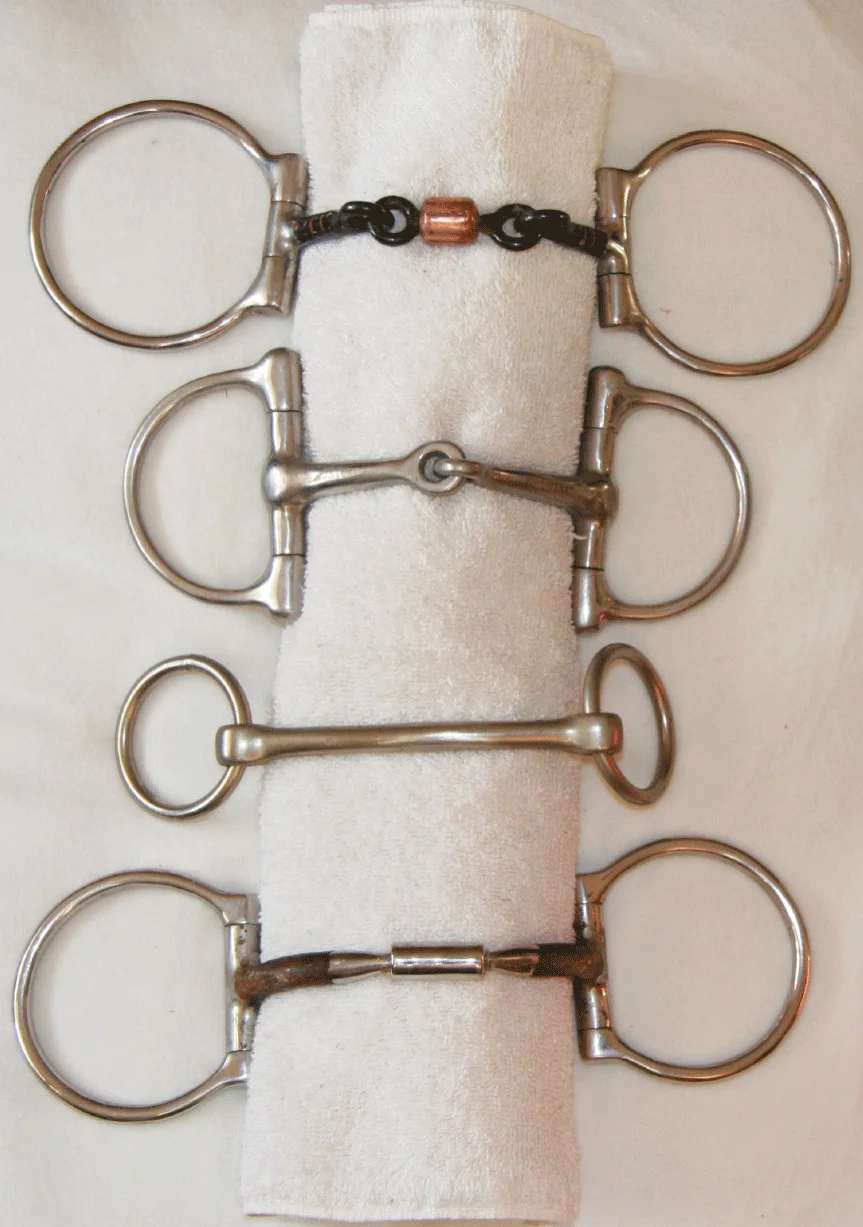
Figure 2. Examples of different snaffle bit mouthpieces. A bit that
is broken in more than one location (top) shapes around the tongue,
distributing pressure equally over the tongue and bars. A bit that is broken in
one place (second from top) places pressure more on the bars of the mouth. A
solid bit (second from bottom) places pressure more on the middle of the
tongue. A barrel-hinged mouthpiece (bottom) has a limited range of motion.
After
determining whether to use a snaffle or a curb and deciding on the appropriate
width and material, the next step is to determine the style of mouthpiece
needed. Selecting a mouthpiece is where much of the confusion surrounding bits
begins. This is due in part to the vast number of mouthpieces available, and
also to the lack of understanding of the conformation of the mouth and how the
various mouthpieces fit and function in the mouth. It is possible to have a
mouthpiece that is mild in its action and pressure (a soft bit) or severe (a
harsh or hard bit). As previously stated, both a snaffle bit and curb bit may
have either a broken or solid mouthpiece. How well a horse responds to a
certain type of mouthpiece depends on each horse's mouth conformation and
preference. The more broken (jointed) the mouthpiece is, the more it will
conform to the horse's mouth. A mouthpiece that is broken in several places
will conform around the tongue more than a mouthpiece that is solid or only
broken in one place. A mouthpiece that is solid will place more pressure across
and over the tongue while one that is broken in the middle will take some
pressure off the center of the tongue when the reins are pulled, thereby
placing pressure more on the bars of the mouth and the sides of the lips. A bit
that is broken in multiple places will conform around the tongue and place
pressure more equally over the tongue, bars and lips. Some horses with shallow
palates are more comfortable with bits that conform around their mouth.
Mouthpieces broken in only one place might come into contact with the horse's
palate as the rider pulls back on the reins and the mouthpiece closes at the
break. Each horse responds differently to different types of bit pressure; some
horses respond better to bits that are solid while some respond better to bits
that are broken. The rider must experiment to determine which bit a particular
horse performs better in.
Snaffle
Bits:
When
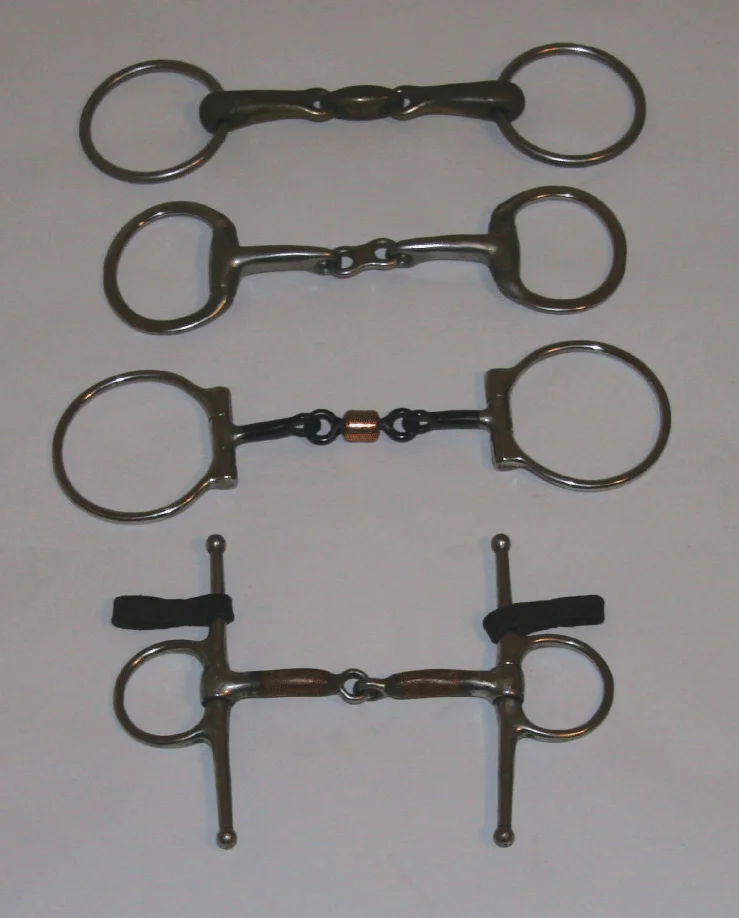
choosing a snaffle bit, the ring design must be considered. Snaffle bits
typically are available in O-ring, D-ring, egg butt and full cheek
configurations. The rings can vary in size from 2 1/2 inches in diameter to 4
inches, with 3 inches being fairly standard. O-ring and egg butt bits are
probably the most popular styles. Full cheek bits are also popular, but should
always be used with bit keepers for safety reasons; a full cheek bit that is
not properly secured with a bit keeper can easily get snagged on surrounding
items or injure nearby horses and riders. Full cheek bits and very large ringed
bits are used in some training situations to apply pressure to the side of the horse's
face when being asked to yield laterally, thereby encouraging the horse to
yield better and also to prevent the bit from being pulled through the mouth.
Bit Severity:
When
using a snaffle bit, the main factors that affect severity are diameter and mouthpiece
texture. A larger diameter mouthpiece results in the pressure applied to the
tongue and bars being diffused over a larger surface area. This makes these
bits less severe than a bit with a smaller diameter mouthpiece, which
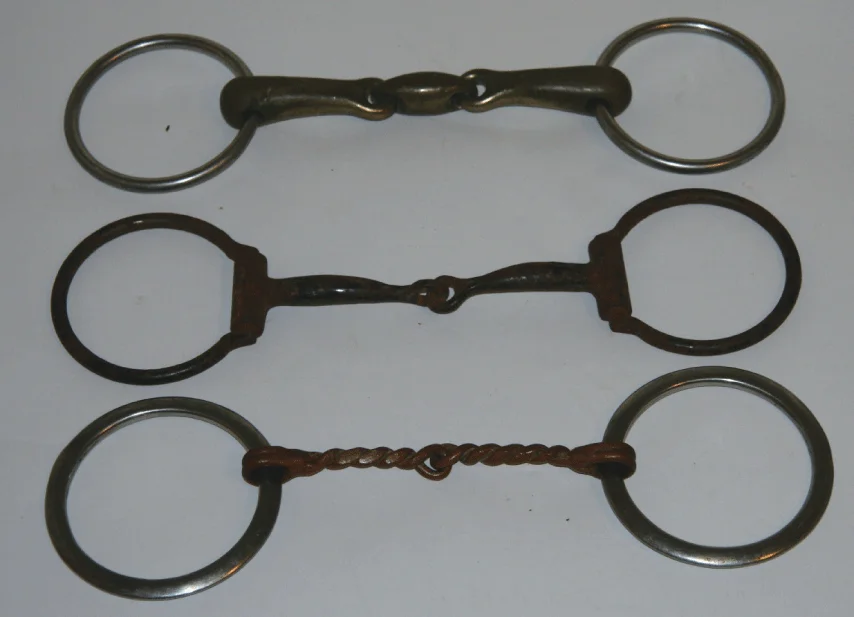
concentrates the pressure into a smaller area. Mouthpieces can be either smooth
or textured.
A
common texturing technique is to make a bit with twists in the mouthpiece,
which can either be slow and rather smooth or fine and sharp. The thinner and
sharper the twist, whether a corkscrew type or twisted wire, the more severe
the mouthpiece since pressure will be concentrated in those areas. There are
many gradations between the two extremes of soft and harsh bits, and a moderate
bit is probably the best choice for most people and horses. Harsher bits should
be reserved for people who know how and when to use them and have the patience
and dexterity to use them properly. Soft bits can also be problematic because
is easy to teach a horse to pull against and evade them. This is certainly not
desirable, though many people make this mistake in trying to be kind to their
horse. A second problem associated with soft bits is that they are generally
large in diameter and many young horses may not have enough room in their mouth
to comfortably carry them, as discussed earlier with rubber bits. This can lead
to annoying habits such as excessive mouthing of the bit.
Curb
Bits:
Selecting
a curb bit is similar to selecting a snaffle bit; however, in addition to
selecting the type and size of the mouthpiece, it is important to determine the
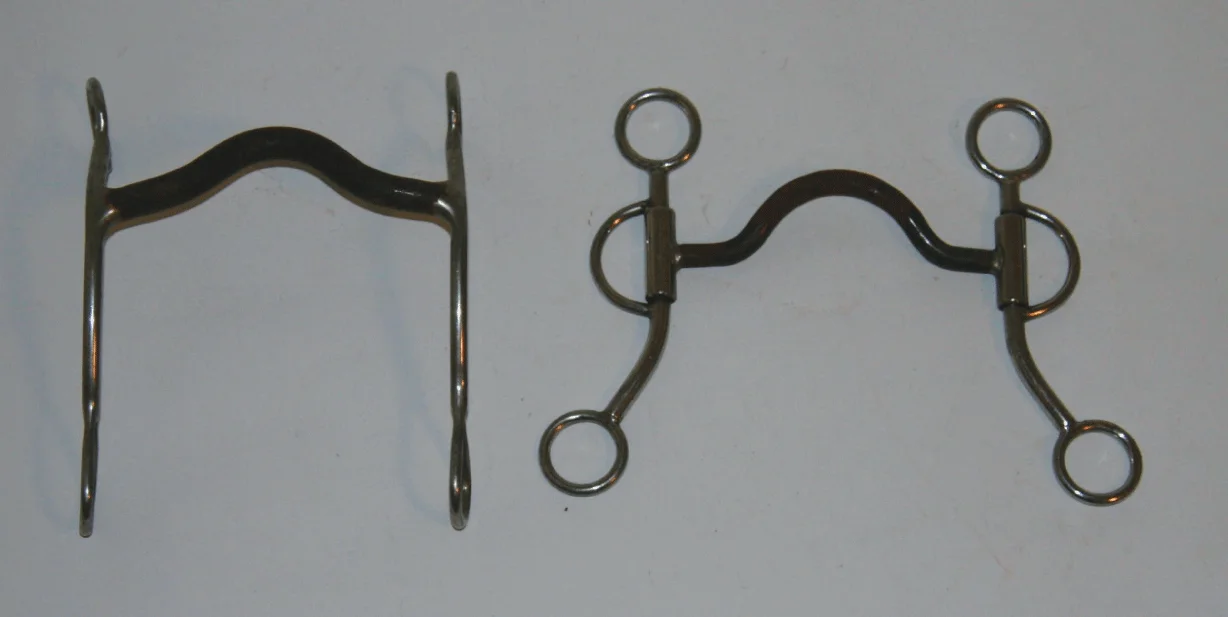
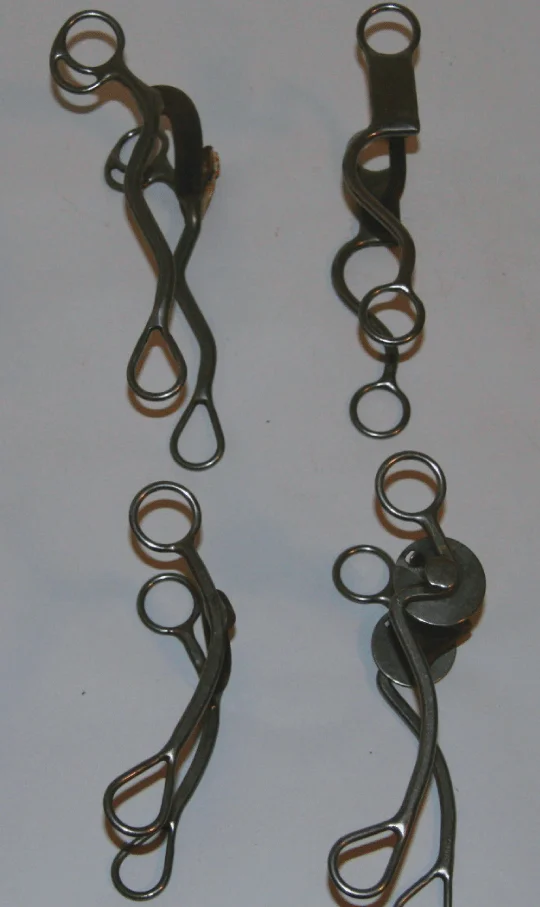
appropriate shank. The shank can be either a solid cheek or a shank that can
swivel (swivel cheek). It is also critical to determine what length and shape
of shank is desired. Shanks are available in several styles. They may be
straight, have a gentle sweep (C-bit), an acute sweep (grazing bit) or a
variety of patterns (S shank, 7 shank, cavalry shank). Shank length determines
the bit's severity. The average shank length is 6 to 7 inches, but may vary
from approximately 4 inches to 8-plus inches. It is important to understand
certain principles about leverage bits. A straight shank, in comparison to a
curved shank, is quicker acting. A longer shank produces more leverage than a
shorter shank, but is slower acting. The ratio of the amount of shank above the
mouthpiece to the amount of shank below the mouthpiece also helps to determine
bit severity; the longer the shank is below the mouthpiece in comparison to the
length of shank above the mouthpiece, the more leverage the bit will have. Bits
that have broken mouthpieces and/or swivel cheeks are slower acting and provide
the horse with what essentially amounts to a preparatory signal.
Another
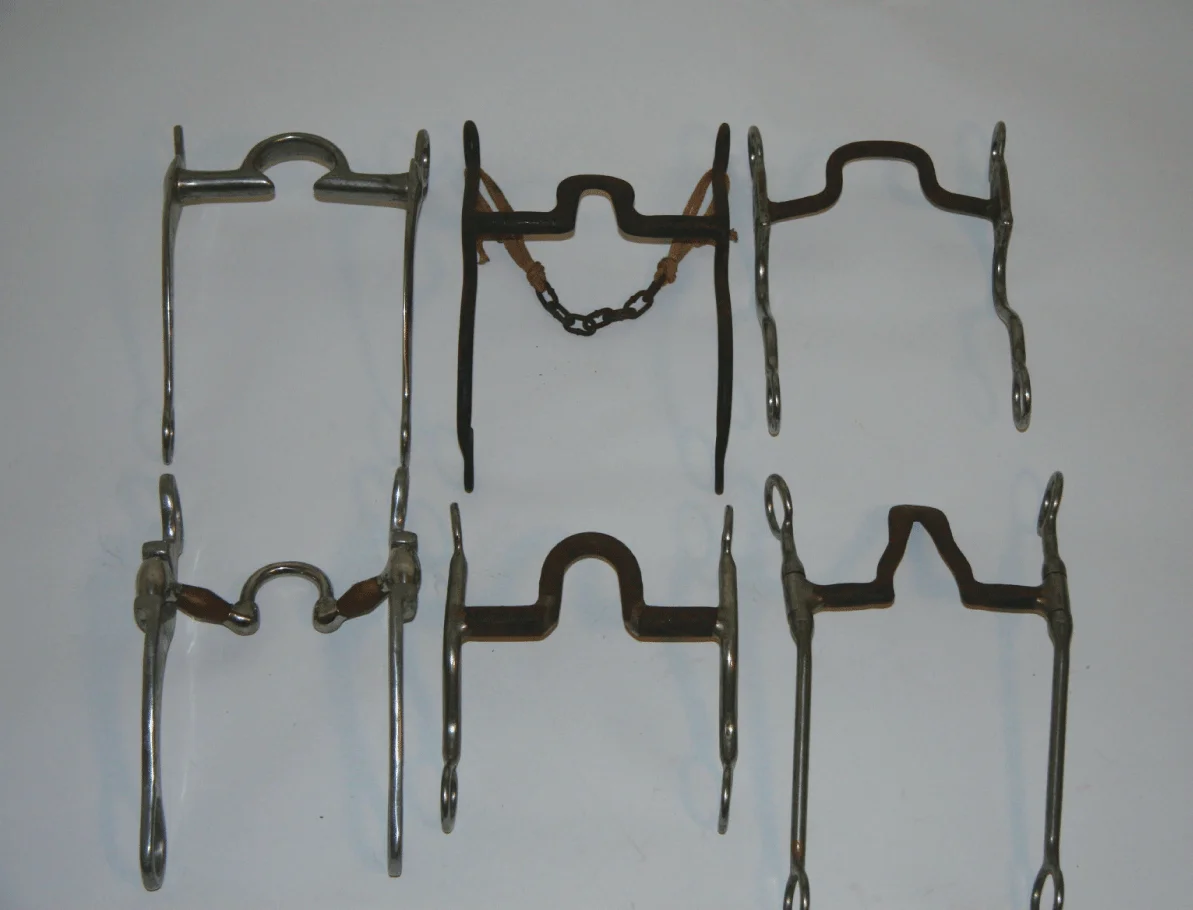
aspect to consider when selecting curb bits is the port. A port is simply an
area in the center of the mouthpiece that deviates from a straight line and,
therefore, is raised off of the tongue as the bit is rotated by rein pressure.
A port can be in the shape of a half square, a half-moon or a triangle. The
port provides tongue relief because as the rider pulls back on the reins, the
horse's tongue moves inside the port, thereby placing more pressure on the bars
of the mouth and less on the tongue. Some horses may prefer this type of bit
and respond well to it while others may not. A port does not come into contact
with the roof of the horse's mouth until it reaches a certain size (ports
greater than approximately 2 inches may come into contact with the roof of the
mouth) and is dependent upon how tight the curb strap is adjusted. A high port
is found in correction bits and cathedral bits and should only be used on
highly trained horses and by riders who have the knowledge to use them
effectively and correctly. The function of a high port is to bump the roof of
the horse's mouth, causing the horse to respond by lowering its head and
flexing at the poll with minimal pressure applied to the reins. This is a
learned response and should only be used on "finished" horses that
have already learned to yield readily to rein pressure.
Other
Types of Bits:
Although
there are many different factors to consider when selecting a bit, it is
important to understand that there are always exceptions and modifiers to most
rules. Not every bit fits neatly into a category, especially when trying to
classify everything as either a snaffle or traditional curb. In addition, it is
not possible to classify bits as either English bits or Western bits.
Kimberwick, pelham, gag and elevator bits should be considered combination
bits, in that their action is not exactly that of a snaffle or true curb bit.
Conclusion
Regardless
of the bit selected, the rider's hands are the most important factor in
communicating with the horse and influencing bit effectiveness and severity.
Correct use of hands is critical in determining bit performance. In most
instances, the problems perceived as resulting from not having the correct bit
are in reality training problems. There are many instances when using the
appropriate bit can enhance the training process. On the other hand, using an
inappropriate bit may produce undesired responses such as resistance to
pressure, head shaking, excessive mouthing of the bit, excessive reaction to
the bit (such as rearing) or overflexing at the poll. It is important to find a
bit that works well for both horse and rider based on the experience level of
both. Inexperienced riders or horses should be equipped with softer, less
severe bits. Inexperienced riders lack the hand control to use more severe bits
effectively without damaging the horse's mouth. Inexperienced horses often have
not learned the desired responses to bit cues and may be confused or
overwhelmed by severe bits. It is important to experiment with bit selection to
determine which bit works best for a particular horse and rider combination.